Echeni Medical support ship
NL-FS21-A1
TL-12
The 600 ton Echeni class Medical ship was developed to
provide extended endurance medical support facilities where they are needed.
It is capable of supporting 24 patients, as well as holding 24 more in medical
low berth. The ship, which has a streamlined polymer submergence hull, may
be deployed to rescue operations in almost any environment, disaster relief
or simply support to remote operations. A nuclear damper, unusually manned
by the steward, enables the ship to operate with relative safety in radiation
hot zones.
The ship is capable of Jump-1 and 2G maneuver. The ship has the endurance to stay on site for extended periods, carrying enough fuel and life support for at least 3 months of operations (fully crewed, with full medical staffing and 24 patients). It also carries enough fuel to complete 2 jumps. This may be utilized to reach the far extents of a system and return without needing to refuel. The fuel gathering and processing facilities enable the ship to refuel from ice asteroid, liquid water or gas giant.
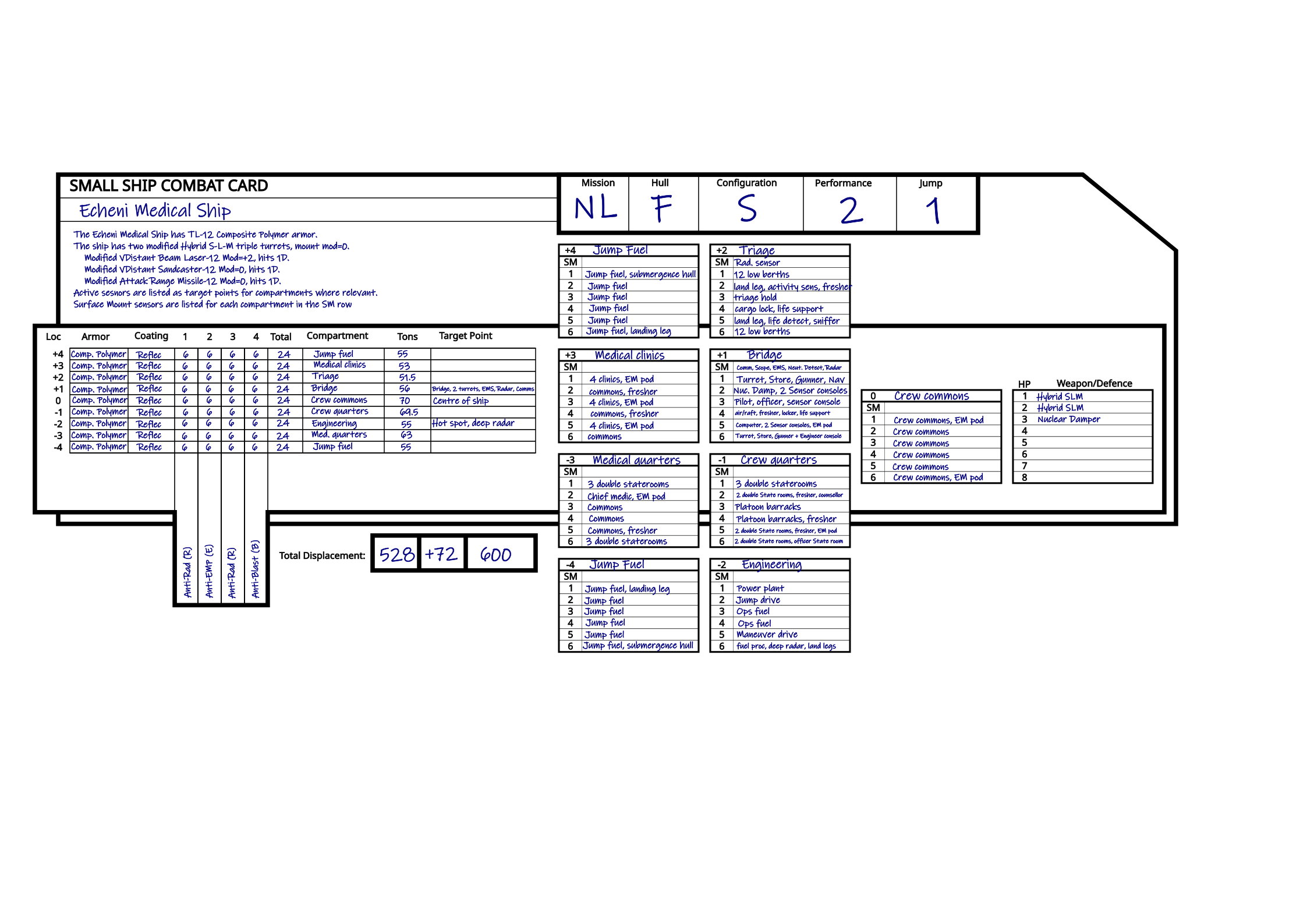
The ship carries an extensive sensor suite; 4 hardpoints are taken up with sensor antennas along with several surface mount sensors. The remaining 2 hardpoints each house a modified Hybrid SLM triple turret. The ship carries a range of sensor probe missiles in the stores.
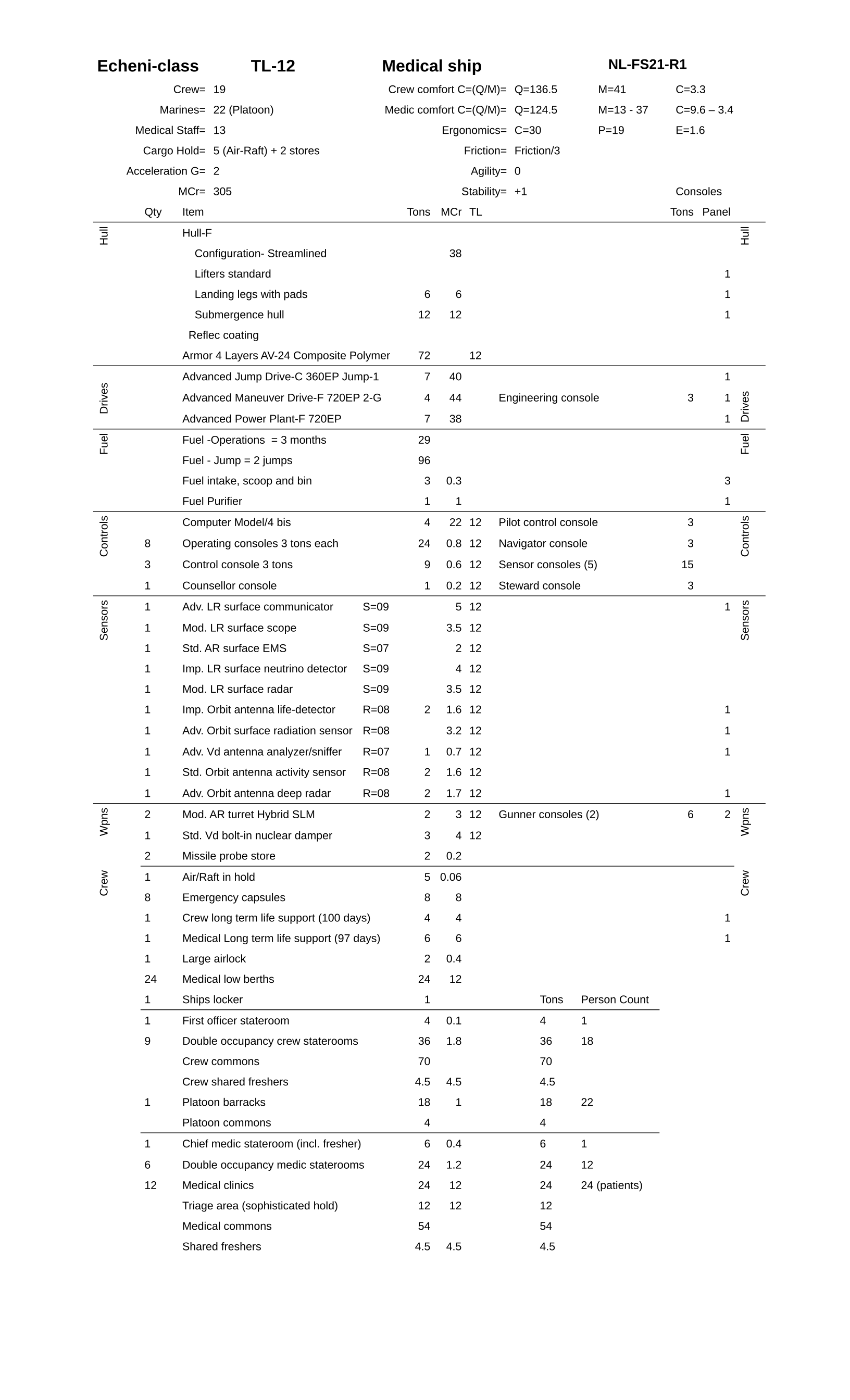
The chief medical officer has overall command of the ship. There are 12 additional medical staff. All of the 3 control and 8 operating consoles are on a reasonably spacious bridge, giving an ergonomics factor of over 1. There are 19 crew, made up of a first officer, 2 pilots, 2 engineers, 2 navigators, 2 stewards and 10 sensor operators. Ship security, operators for the gunnery consoles and whatever man power the ship requires is provided by a platoon of 22 ship troops. A shift pattern of two 12 hour shifts is typical but may be varied according to requirements.
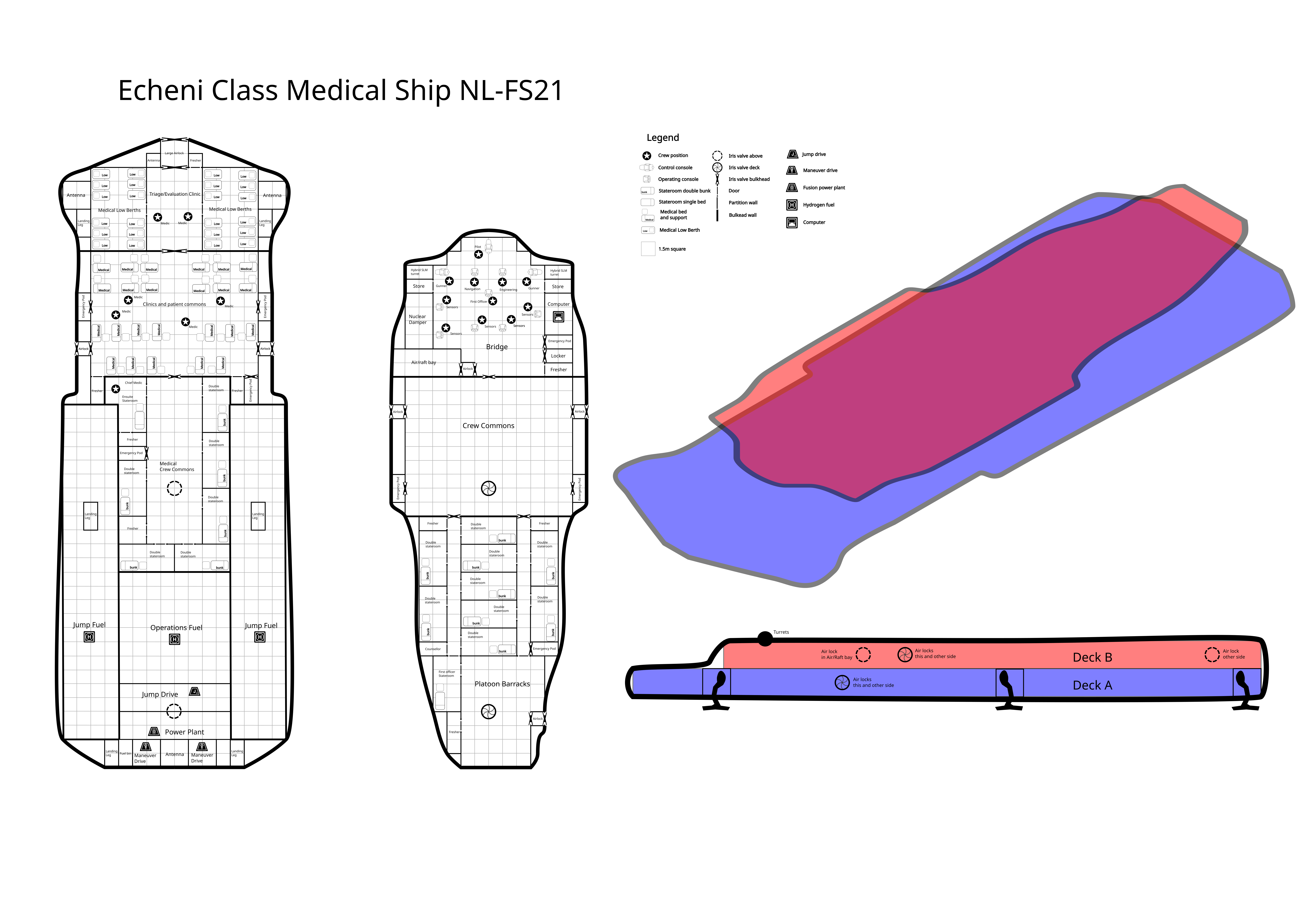
On level 1, a large air/lock leads into a triage area (calculated as a sophisticated hold). On either side of Triage are sub compartments, each containing 12 medical low berths. Beyond Triage is the main clinic area, able to support 24 patients. Further into the ship are the medical staff quarters and commons. Fully staffed with 13 medics and with 24 patients the comfort level for the medical sections is over 3.
The engineering compartment whilst on level 1 cannot be directly accessed from the medical areas, access is provided by an iris lock in the platoon barracks above. Level 2 houses the bridge, extensive crew commons and crew quarters, including the troops’ barracks. A small hold accessible from the bridge, houses an air/raft; useful for resupply of the sensor probe stores. With a full complement of 19 crew and 22 troops the spacious accommodation has a comfort level of over 3.
The medical areas (Triage, Medical Clinic and Medical staff quarters compartments) have separate life support to the ship crew areas (Crew quarters, Crew Commons, Bridge and Engineering compartments); enabling the crew to be isolated from a contagion.
Eight emergency capsules are sufficient to accommodate the medical staff, crew, ship’s troops and patients (though not those in low berths). It should be noted that 2 of the emergency capsules on level 1 (one in the clinics area and one in the medical staff accommodation) launch down out of the ship. 2 of the emergency pods on level 2 (one on the bridge and one in crew accommodation) launch out the top of the ship. The other emergency pods launch out of the sides.
The deck plans do not detail the submergence hull, armor or life support which I’ve considered to be distributed. Nor fuel purification, fuel intake and fuel scoops which are in the engineering compartment, distributed below the drives, only the fuel bins are shown which open to the rear of the ship.
The ship is capable of Jump-1 and 2G maneuver. The ship has the endurance to stay on site for extended periods, carrying enough fuel and life support for at least 3 months of operations (fully crewed, with full medical staffing and 24 patients). It also carries enough fuel to complete 2 jumps. This may be utilized to reach the far extents of a system and return without needing to refuel. The fuel gathering and processing facilities enable the ship to refuel from ice asteroid, liquid water or gas giant.
The ship carries an extensive sensor suite; 4 hardpoints are taken up with sensor antennas along with several surface mount sensors. The remaining 2 hardpoints each house a modified Hybrid SLM triple turret. The ship carries a range of sensor probe missiles in the stores.
The chief medical officer has overall command of the ship. There are 12 additional medical staff. All of the 3 control and 8 operating consoles are on a reasonably spacious bridge, giving an ergonomics factor of over 1. There are 19 crew, made up of a first officer, 2 pilots, 2 engineers, 2 navigators, 2 stewards and 10 sensor operators. Ship security, operators for the gunnery consoles and whatever man power the ship requires is provided by a platoon of 22 ship troops. A shift pattern of two 12 hour shifts is typical but may be varied according to requirements.
On level 1, a large air/lock leads into a triage area (calculated as a sophisticated hold). On either side of Triage are sub compartments, each containing 12 medical low berths. Beyond Triage is the main clinic area, able to support 24 patients. Further into the ship are the medical staff quarters and commons. Fully staffed with 13 medics and with 24 patients the comfort level for the medical sections is over 3.
The engineering compartment whilst on level 1 cannot be directly accessed from the medical areas, access is provided by an iris lock in the platoon barracks above. Level 2 houses the bridge, extensive crew commons and crew quarters, including the troops’ barracks. A small hold accessible from the bridge, houses an air/raft; useful for resupply of the sensor probe stores. With a full complement of 19 crew and 22 troops the spacious accommodation has a comfort level of over 3.
The medical areas (Triage, Medical Clinic and Medical staff quarters compartments) have separate life support to the ship crew areas (Crew quarters, Crew Commons, Bridge and Engineering compartments); enabling the crew to be isolated from a contagion.
Eight emergency capsules are sufficient to accommodate the medical staff, crew, ship’s troops and patients (though not those in low berths). It should be noted that 2 of the emergency capsules on level 1 (one in the clinics area and one in the medical staff accommodation) launch down out of the ship. 2 of the emergency pods on level 2 (one on the bridge and one in crew accommodation) launch out the top of the ship. The other emergency pods launch out of the sides.
The deck plans do not detail the submergence hull, armor or life support which I’ve considered to be distributed. Nor fuel purification, fuel intake and fuel scoops which are in the engineering compartment, distributed below the drives, only the fuel bins are shown which open to the rear of the ship.
Details
Deckplan
Combat Card
The Traveller game in all forms is owned by Far Future Enterprises.
Copyright 1977 – 2024 Far Future Enterprises. Traveller is a registered
trademark of Far Future Enterprises. Far Future permits web sites and
fanzines for this game, provided it contains this notice, that Far Future
is notified, and subject to a withdrawal of permission on 90 days notice.
The contents of this page are for personal, non-commercial use only. Any
use of Far Future Enterprises’s copyrighted material or trademarks anywhere
on this web page and its file should not be viewed as a challenge to those
copyrights or trademarks. In addition, this program/file on this site cannot
be republished or distributed without the consent of the author who
contributed it.